

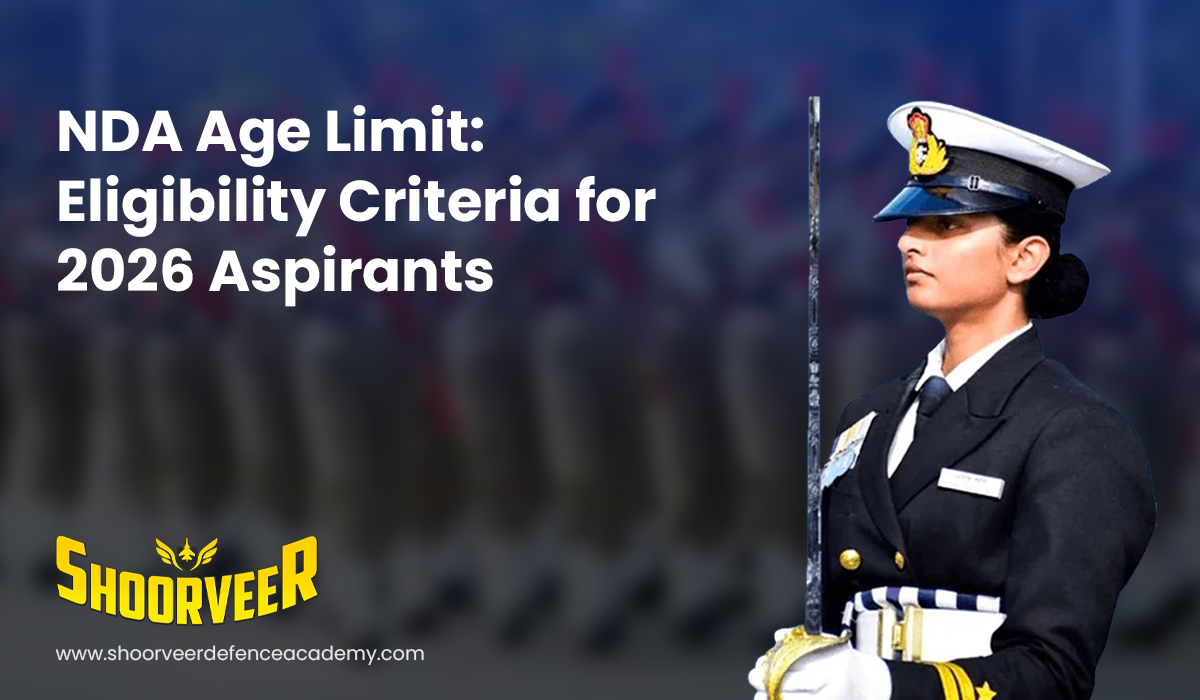
The National Defence Academy (NDA) exam is one of the most prestigious entrance examinations in India for students aspiring to join the Armed Forces. Every year, lakhs of candidates from across the country appear for this exam with dreams of serving the nation as officers in the Indian Army, Navy, or Air Force.
However, before beginning their NDA preparation, aspirants must understand the basic eligibility criteria—especially the NDA age limit. Many candidates get disqualified simply because they do not meet the age requirements, even if they are otherwise capable of clearing the exam.
In this detailed guide, we will cover:
-
The NDA age limit for 2026 aspirants
-
Other important eligibility criteria
-
How the age criteria impact your preparation timeline
-
Common mistakes students make regarding NDA age eligibility
-
The role of NDA Coaching in Rajasthan in maximizing your chances of success
-
Insights into the NDA syllabus and preparation strategies
By the end of this blog, you will have a complete understanding of whether you qualify for the exam and how to plan your journey toward cracking the NDA in 2026.
NDA Exam Overview
The NDA exam is conducted twice a year by the Union Public Service Commission (UPSC), usually in April and September. The exam is followed by the Services Selection Board (SSB) Interview, medical examination, and final merit list.
-
Mode of Exam: Offline (pen and paper)
-
Subjects: Mathematics and General Ability Test (GAT)
-
Selection Stages: Written exam, SSB Interview, medical test
-
Final Outcome: Admission to NDA (Khodaikanal, Pune) and training as cadets
Since the competition is intense and only a small percentage of aspirants get through, having clarity on the eligibility criteria is the first step toward planning your NDA preparation journey.
NDA Age Limit 2026 – Key Criteria
The NDA age limit is one of the most crucial eligibility conditions. For the NDA 2026 exams (NDA 1 & NDA 2), the expected age criteria will be:
-
NDA 1 2026: Candidates must be born between 2nd July 2007 and 1st July 2010.
-
NDA 2 2026: Candidates must be born between 2nd January 2008 and 1st January 2011.
This means:
-
Minimum age: 16.5 years
-
Maximum age: 19.5 years
Important Notes:
-
No relaxation in age is provided for any category (SC, ST, OBC, or others).
-
Candidates must ensure that their date of birth matches the matriculation certificate.
-
If your age exceeds the maximum limit even by a day, you will not be eligible.
Educational Qualification for NDA 2026
Apart from the age limit, candidates must fulfill certain academic requirements:
-
For Army Wing: Passed Class 12 or equivalent examination from a recognized board.
-
For Air Force & Navy Wings: Passed Class 12 with Physics and Mathematics as compulsory subjects.
-
Candidates appearing for Class 12 exams in 2026 are also eligible, provided they submit proof of passing before admission.
Nationality Requirements
To apply for NDA, you must be:
-
A citizen of India, or
-
A subject of Bhutan or Nepal, or
-
A Tibetan refugee who came to India before January 1, 1962, with the intention of settling permanently, or
-
A person of Indian origin who migrated from Pakistan, Burma, Sri Lanka, and East African countries.
Physical Standards
The Armed Forces demand high levels of fitness. Candidates must meet the following criteria:
-
Height: Minimum 157 cm (162.5 cm for Air Force).
-
Vision: 6/6 in one eye and 6/9 in the other, correctable to 6/6.
-
Medical Fitness: Free from diseases and physical disabilities.
-
Candidates who have undergone LASIK surgery or are overweight/underweight may face rejection.
Why NDA Age Limit Matters for 2026 Aspirants
The NDA age eligibility decides when a student can attempt the exam. Since NDA is held twice a year, students usually get 4–5 chances between the ages of 16.5 to 19.5.
-
If you are currently in Class 10 or 11, your first chance may come in NDA 1 2026.
-
If you are in Class 12 in 2026, it may be your last or second-last attempt.
Hence, knowing your age eligibility helps you strategically plan your NDA preparation and avoid missing any attempt.
NDA Syllabus 2026 – Key Areas
While understanding eligibility is crucial, aspirants must also be familiar with the NDA syllabus, which determines the level of preparation required.
Mathematics (300 marks)
-
Algebra
-
Trigonometry
-
Probability
-
Statistics
-
Calculus
-
Vectors
-
Matrices & Determinants
General Ability Test (600 marks)
Part A – English (200 marks)
-
Grammar
-
Vocabulary
-
Reading comprehension
-
Sentence structure
Part B – General Knowledge (400 marks)
-
Physics
-
Chemistry
-
General Science
-
History & Freedom Movement
-
Geography
-
Current Affairs
NDA Preparation Tips for 2026 Aspirants
Cracking the NDA exam is not just about intelligence—it’s about consistent effort, discipline, and strategic preparation. The competition is fierce, with lakhs of aspirants competing for limited seats, which makes following the right approach crucial. Below are some proven NDA preparation tips for 2026 aspirants:
1. Start Early
Many aspirants wait until Class 12 to begin their NDA preparation, but starting earlier gives you a clear advantage. If you are in Class 10 or 11, focus on:
-
NCERT Books: These form the base of Mathematics, Science, and General Knowledge. Clearing concepts early ensures you don’t struggle with the NDA syllabus later.
-
Parallel Study: By starting early, you can prepare for NDA along with your school exams. This integrated approach saves time and effort.
-
Foundation for SSB: Developing communication skills, confidence, and leadership qualities from school days helps you at the SSB stage.
2. Focus on Mathematics and English
Mathematics and English are considered the game-changers in the NDA written exam. Many aspirants clear the GAT but fail because of low scores in Mathematics or English. Here’s how to strengthen these subjects:
-
Mathematics Preparation
-
Revise Class 11 and 12 NCERT Mathematics thoroughly.
-
Pay special attention to Algebra, Trigonometry, Calculus, Probability, and Vectors.
-
Solve at least 20–30 problems daily and practice previous years’ NDA question papers.
-
Work on speed and accuracy since Mathematics has 120 questions with strict time limits.
-
-
English Preparation
-
Improve grammar by practicing error detection, sentence correction, and fill-in-the-blanks.
-
Enhance vocabulary through daily word lists and reading.
-
Practice comprehension passages regularly to improve reading speed.
-
Write short essays or summaries to sharpen writing skills.
-
3. Build General Knowledge
General Knowledge (GK) plays a vital role in the General Ability Test (GAT), which carries 600 marks. To score well:
-
Current Affairs: Stay updated with daily national and international news. Focus on defence-related developments, government policies, and international relations.
-
Static GK: Revise important topics from History, Geography, Polity, and Economics.
-
Science Basics: Physics, Chemistry, and Biology questions are often asked from Class 9–12 NCERTs.
-
Reading Habit: Newspapers like The Hindu or Indian Express, along with monthly current affairs magazines, are useful.
4. Practice Mock Tests
One of the most common mistakes aspirants make is not testing themselves enough before the actual exam. Mock tests prepare you for real exam conditions.
-
Time Management: With limited time for 270 questions, practicing mock tests helps you learn where to speed up and where to slow down.
-
Identifying Weak Areas: Analyzing mock tests highlights your strong and weak subjects. Focus on weak topics before the exam.
-
Boosting Confidence: Regular practice reduces exam-day anxiety and builds confidence.
5. Work on Physical Fitness
The NDA journey doesn’t end with the written exam. The SSB Interview and medical tests are equally challenging, and physical fitness plays a huge role.
-
Daily Exercise Routine: Include running (2–3 km daily), push-ups, sit-ups, pull-ups, and rope climbing in your fitness schedule.
-
Stamina & Endurance: Focus on swimming, cycling, and team sports to build endurance and agility.
-
Mental Fitness: Along with physical training, practice meditation and yoga to improve focus, confidence, and stress management.
-
SSB Preparation: Since SSB includes physical group tasks, teamwork, and outdoor activities, fitness is key to performing well.
Common Mistakes Aspirants Make About NDA Eligibility
-
Not verifying age with the official notification – Many students assume they are eligible without checking UPSC dates.
-
Ignoring physical fitness – Even if you clear the written exam, medical unfitness can disqualify you.
-
Delaying preparation – Waiting until Class 12 often leaves aspirants with only 1–2 attempts.
-
Mismanaging subjects – Neglecting Mathematics or English reduces chances drastically.
Role of NDA Coaching in Rajasthan
While self-study is possible, structured guidance from an NDA Academy in Rajasthan can make preparation more focused and result-oriented. Rajasthan has become a hub for NDA coaching due to:
-
Experienced faculty specializing in NDA preparation
-
Integrated courses covering NDA syllabus and school curriculum
-
Regular mock tests and practice sessions
-
Special focus on SSB interview training
-
Disciplined environment, mirroring military life
Students from across India, especially from rural areas, choose Rajasthan because of its reputation for producing successful NDA candidates.
Final Thought
Understanding the NDA age limit is the first step for every 2026 aspirant. With an eligibility window of just 16.5 to 19.5 years, candidates must plan their preparation wisely and utilize each attempt effectively. Along with age and academic qualifications, physical fitness and discipline are equally important.
For aspirants serious about their dreams, enrolling in a reputed NDA Coaching in Rajasthan can provide the right mentorship, strategy, and competitive environment to succeed. One of the most trusted institutions guiding students toward NDA success is ShoorVeer Defence Academy, where thousands of aspirants have shaped their journey into becoming future officers of the Indian Armed Forces.
 Call +91-7240372408
 Website: www.shoorveerdefenceacademy.com